
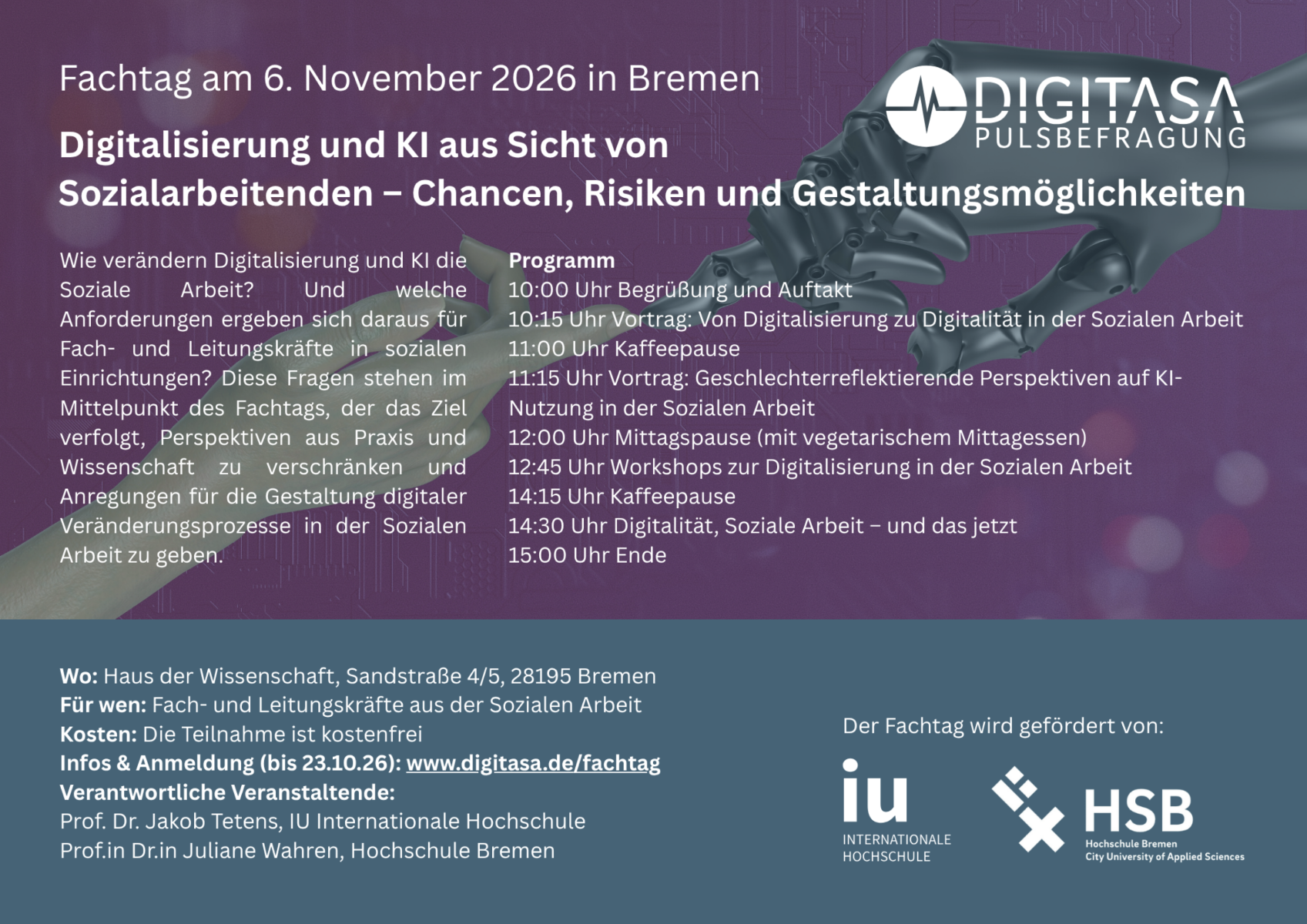
Digitalisation and AI in social work: DIGITASA conference on 6 November in Bremen
Four universities, including IU, present results from five years of research on the impact of digitalization and AI on social work
Four universities, including IU International University of Applied Sciences, present results from five years of research on the impact of digitalisation and AI on social work.
Bremen, 13 October 2026. Digital technologies and AI applications are transforming social work – in counseling, documentation, and the organisation of institutions. How do professionals and managers experience these changes? What helps them, and what overwhelms them? And where are there currently lacking regulations?
These questions will be the focus of the DIGITASA conference on Friday, 6 November 2026, at the House of Science in Bremen. It is being organised by IU International University of Applied Sciences and Bremen University of Applied Sciences.
“Digital transformation is being shaped concretely in social work institutions – not in strategy papers,” says Prof. Dr Jakob Tetens, Professor of Social Work at IU in Bremen. “Therefore, spaces are needed where professionals and managers, academia and practice can engage in dialogue and develop viable perspectives.”
Prof. Dr Juliane Wahren from Bremen University of Applied Sciences adds: "It is no coincidence that we are bringing this topic to Bremen. The city has a dense landscape of social institutions that are facing precisely these questions."
Five years of research, three nationwide surveys
The conference is based on the research project "DIGITASA – Digitalisation (in) Social Work," conducted by a research team from IU International University of Applied Sciences, Bremen University of Applied Sciences, Merseburg University of Applied Sciences, and the Duale Hochschule Baden-Württemberg. Since 2021, the team has been investigating nationwide, in collaboration with numerous professional and welfare associations, how social workers experience and shape digital transformation processes. The starting point was the profound change in work practices during the pandemic-related contact restrictions of 2020 and 2021. The project now focuses primarily on the use of AI applications, digital skills, and ethical, organisational, and professional challenges.
A key finding across all three nationwide surveys (2021, 2023 and 2025): Digitalisation in social work is not a purely technical issue. It affects the quality of professional relationships, social participation, data protection and responsibility – as well as work organisation, staff development and the question of whether employees are involved in change processes.
The latest survey reveals that AI chatbots like ChatGPT are now among the most frequently used digital tools in social work – two-thirds of respondents (66 per cent) use them professionally, and almost a third (29 per cent) use them at least once a week. However, there is hardly any binding guidance on their use: only ten per cent of institutions had a guide to AI usage in 2025. Learning tends to happen more through informal conversations: across all hierarchical levels, informal exchanges with colleagues are the most common source of information. Fewer than 40 per cent of respondents cite training and professional development as a source of information on digital technologies – even though the EU AI Act obliges institutions that operate AI systems to promote the AI competence of their staff (Art. 4). In eleven percent of institutions, the use of AI applications is even prohibited, yet almost a quarter of those surveyed there still use them regularly.
Two keynote speeches, four workshops
Two keynote speeches will open the conference: The first will present the developments and trends from all three surveys, while the second will be given by researchers from the University of Graz who will examine gender-reflective perspectives on the use of AI – an aspect that has received little attention in the debate so far. In the afternoon, participants will explore the implications of the findings for specific fields of work in four parallel workshops.
The conference explicitly pursues a transfer objective: results are not only to be presented, but also critically assessed and further developed together with practitioners.
Professionals and managers from all fields of social work are invited. Participation is free of charge; registration is open until 23 October 2026 at www.digitasa.de/fachtag.
About the survey series
Since 2021, DIGITASA has been conducting non-representative online pulse surveys among social workers regarding their use of digitalisation and AI, distributed through professional and welfare associations: n = 488 participants (2021), n = 657 (2023), and n = 662 (2025) from all German federal states. The surveys are independent samples; they show trends, not changes among the same individuals. Since digitally savvy social workers are likely overrepresented, the apparent gaps in concepts and qualifications across the board of practice are probably larger than depicted here. All data refers to professional use.
Note to editors
Media representatives are also cordially invited. We would be happy to arrange interviews with the researchers – either in person on 6 November (e.g., during the lunch break from 12 pm) or by phone/Teams before or after. Please send inquiries and accreditation requests by email to presse@iu.org.
Everything at a glance
What: Conference “Digitalisation and AI from the perspective of social workers – opportunities, risks and design options”
When: Friday, 6 November2026, 10 a.m. – 3 p.m.
Where: House of Science, Sandstraße 4/5, 28195 Bremen (partially wheelchair accessible)
For whom: Social work professionals and managers
Organisers: IU International University of Applied Sciences and Bremen University of Applied Sciences
Research project: DIGITASA by IU International University of Applied Sciences, Bremen University of Applied Sciences, Merseburg University of Applied Sciences and DHBW
Registration: until 23 October 2026 at www.digitasa.de/fachtag
The full programme and further information about the research project can be found at https://www.digitasa.de/.
Press contact
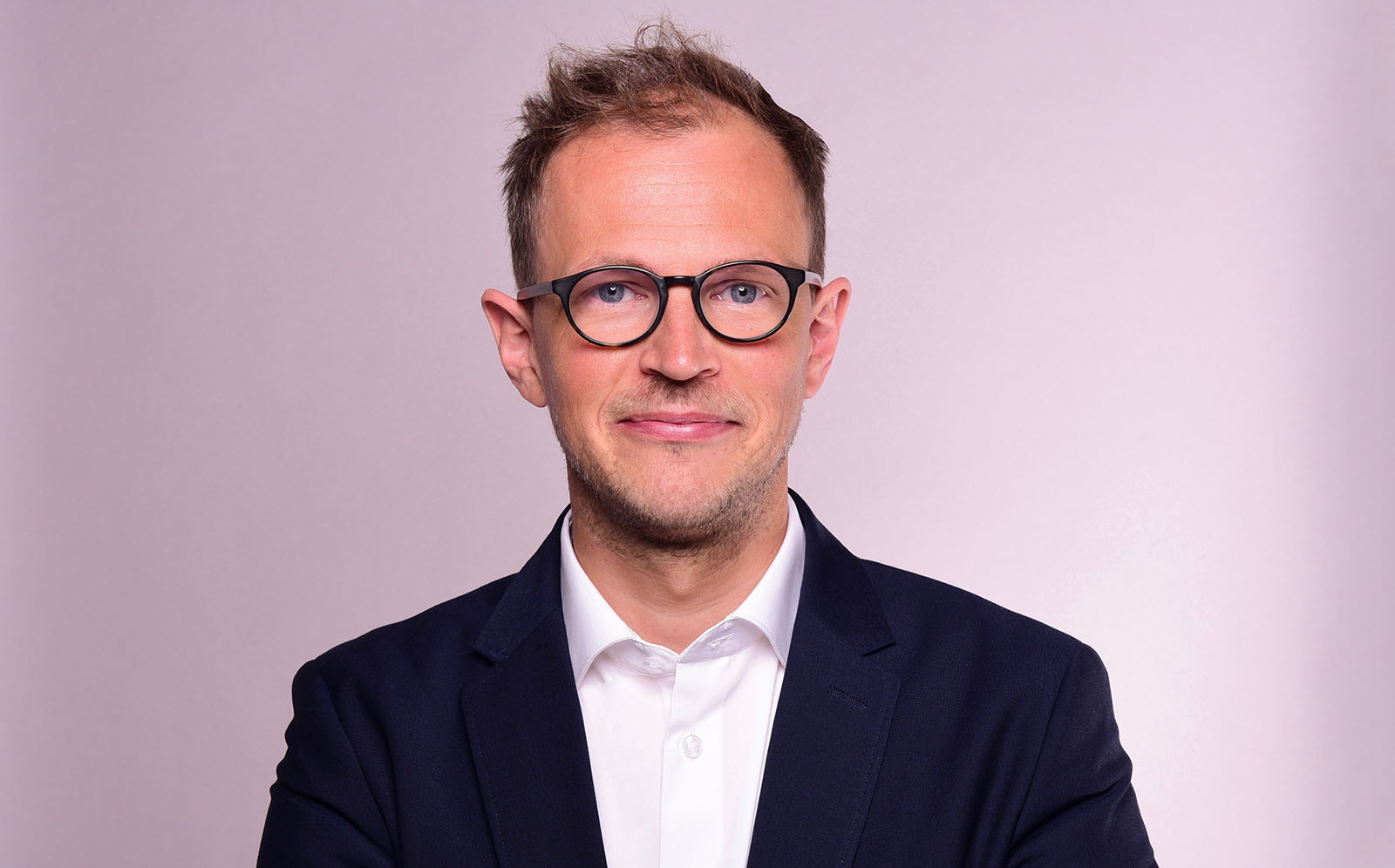
Prof. Dr Jakob Tetens
IU International University of Applied Sciences, Bremen Campus
jakob.tetens@iu.org
Tel. 0421 166985 25
Sources
DIGITASA Survey 2025: https://www.digitasa.de/ergebnisse/digitasa-2025/
DIGITASA Survey 2023: https://www.digitasa.de/ergebnisse/digitasa-2023/
Matthies, A., Sailer, J., Tetens, J. & Wahren, J. (2026): Large Language Models in Social Work. Use, Perspectives and Framework Conditions. Newsletter of the German Association 1/2026, pp. 5–13.
Matthies, A. & Tetens, J. (2026): Digital education of social workers in child and youth welfare in times of generative AI. Evangelische Jugendhilfe 4/2026, pp. 205–215.
EU AI Act, Art. 4 (AI competence; recast by Digital Omnibus, Regulation (EU) 2026/1744, in force since 27 July 2026)
Suggested citation for study data: Matthies, A., Sailer, J., Tetens, J. & Wahren, J. (2025): DIGITASA 2025 – Selected results of the third nationwide pulse survey on digitalisation (in) social work, www.digitasa.de.
With over 120,000 students, IU International University of Applied Sciences (IU) is the largest university in Germany. The private, state-recognised educational institution, based in Erfurt, began teaching in 2000 and now has 24 campuses as well as a virtual campus. IU stands for maximum flexibility in study: whether through dual study, distance learning or on campus – students from over 160 nations tailor their educational path to suit their individual circumstances. With more than 200 degree programmes at bachelor’s, master’s and MBA level, IU imparts practical skills. Innovative learning concepts foster targeted, future-proof skills for an increasingly AI-driven world of work. A modern, digitally supported learning environment and the use of artificial intelligence enable effective, personalised learning. As a pioneer in this field, IU has developed its own digital learning companion, ‘Syntea’, which has been in use since 2023. A network of over 15,000 companies – including Motel One, Vodafone, AWO and Deutsche Bahn – makes IU a strong partner in the training of skilled workers and consistently links academic teaching with practical experience. Further information at: iu.org
Contact

|
IU International University of Applied Sciences Press Department |