
IU students present innovative daycare screening tool
Childhood education students present jointly developed instrument for assessing precursor competencies at a conference in Cologne
Students of childhood education presented a jointly developed instrument for assessing precursor competencies at a conference in Cologne.
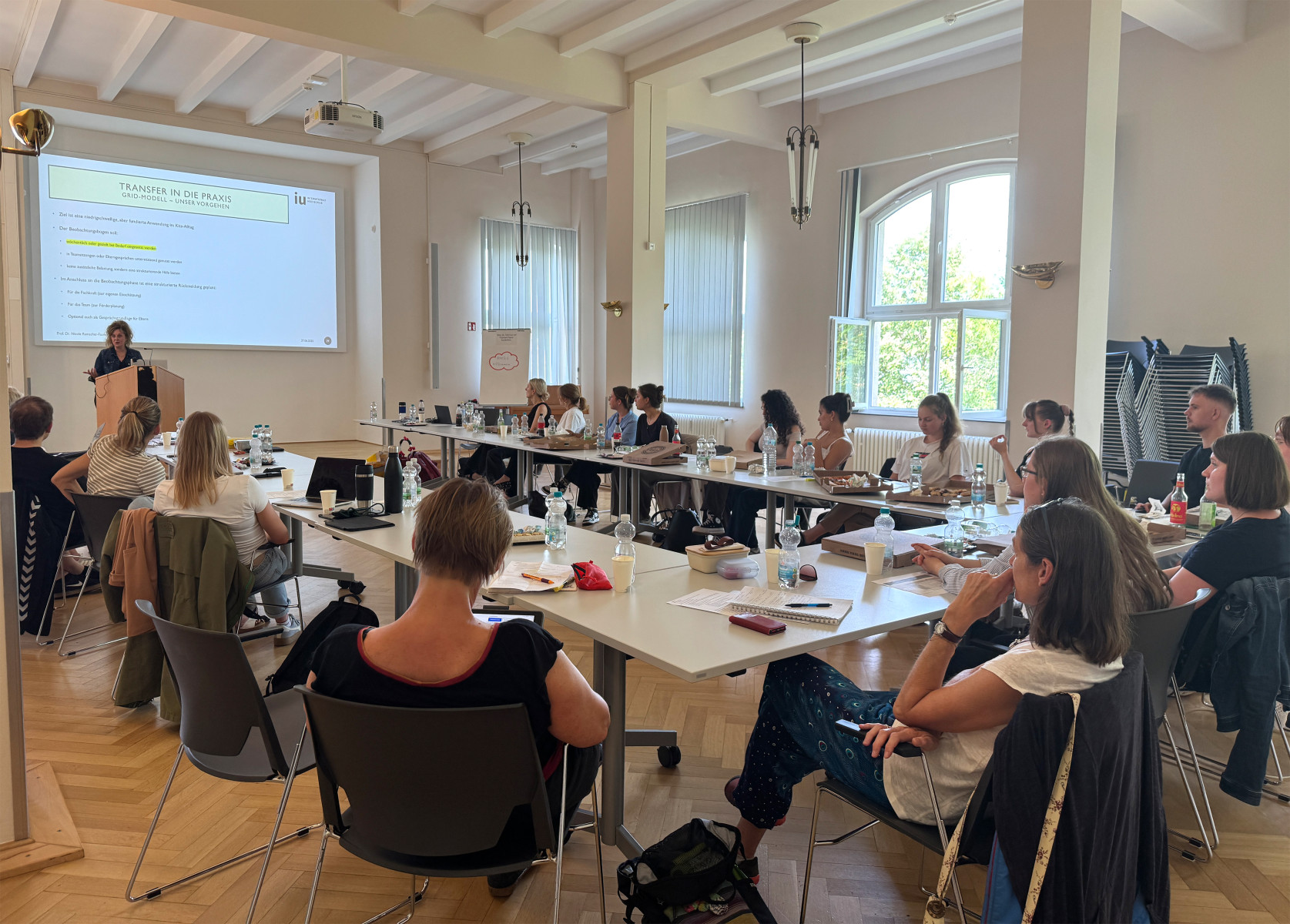
Düsseldorf/Cologne, 29 July 2025. At the end of June, students from IU International University of Applied Sciences presented a newly developed screening tool for daycare centers at a symposium at the University of Cologne on the topic of "Understanding, Supporting, and Shaping Learning Paths – with the GRID Model." Led by Prof. Dr Nicole Ramacher-Faasen, the class from the dual degree programme in Childhood Education presented the GRID daycare screening tool – a tool for the structured and early assessment of children's precursor skills during the transition from daycare to elementary school. In doing so, they provided important input to professionals from academia, schools, and learning therapy on the importance of early childhood education perspectives in children's educational biographies.
GRID daycare screening closes diagnostic gap in early childhood education
The GRID model is a multi-professional concept for multidimensional diagnostics and support planning for learning and behavioral difficulties. It was developed by Dr Edeltraud Hammes-Schmitz at the University of Cologne, extensively validated, and continuously developed further – particularly in the school context. The sixth-semester students from the IU Campus Düsseldorf demonstrated the model's enormous potential for the transition from daycare to elementary school with their developed GRID daycare screening , which closes a key diagnostic gap in the preschool setting.
As the only representatives from the early childhood education field, the IU students provided new food for thought – both for the expansion of the GRID model and for the relevance of early childhood education perspectives in multi-professional discourses.
Prime example of theory-practice transfer
The development process of the GRID daycare screening is an impressive example of a successful transfer between theory and practice. As part of the "Supervision, Intervision & Coaching" module, the dual-study students developed a concept for the structured observation of children's precursor skills. The goal was to create a practical, adaptable tool that would visualise children's skills in their final year of daycare - in seven key areas, from independence to parenting.
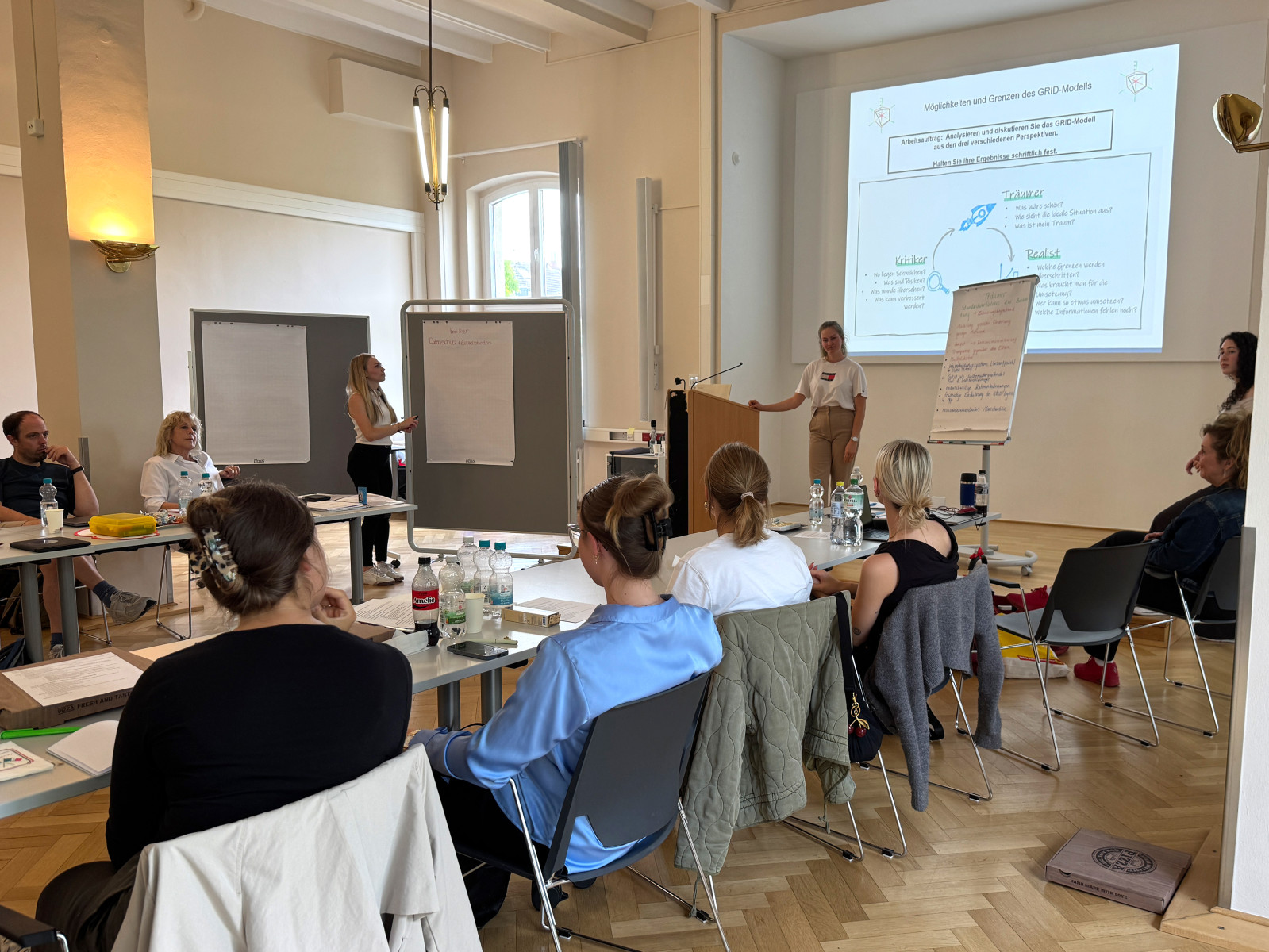
Together with course leader Prof. Dr Nicole Ramacher-Faasen, they researched specialist literature, obtained input from Dr Hammes-Schmitz, held discussions in the seminar, conducted tests in their own practice settings, and collected feedback from professionals and from reflection loops. All of these efforts resulted in a screening instrument that is both scientifically sound and practically applicable.
Particular emphasis was placed on digital implementation: The instrument is optimised for use on a tablet or PC and minimises documentation requirements for professionals. It comprises 49 items that are assessed through observations in everyday life and, with the help of assessment aids, comment fields, and automated evaluations, enable structured support planning.
Students as co-creators of scientifically sound practice
The IU students were not only involved in the concept development, but also supported initial implementations in daycare centers, trained staff, developed supporting materials, and conducted an initial evaluation. Feedback from practitioners confirms: The screening is intuitive, practical, and adaptable.
"Our students impressively demonstrated how application-oriented research can be successful in education," emphasises Prof. Dr Nicole Ramacher-Faasen. "The contribution was not only positively received from a professional perspective, but was also recognised as an example of successful cooperation between academia and practice."
Interactive workshop and specialist lecture convinced the specialist audience
At the conference in Cologne, the students not only delivered their presentations but also independently moderated an interactive working group on the topic "GRID – Between Vision, Reality, and Critique." The workshop stimulated intensive discussions on the potential applications and challenges of the GRID model in various practical fields.
With their commitment, IU students demonstrate how scientifically sound concepts can be put into practical application in dual study programmes – and how educational careers can be actively shaped during their studies.

"IU's presence at the conference was more than just a presentation - it was a contribution to the further development of a practical, evidence-based diagnostic tool," summarises Ramacher-Faasen. "The students took on responsibility, contributed their practical experience, and demonstrated that studies and research don't have to remain theoretical, but can generate concrete solutions to educational challenges. I'm incredibly proud of them."
More information about the dual study programme in Childhood Education can be found at: https://www.iu.de/bachelor/kindheitspadagogik/duales-studium/
With over 120,000 students, IU International University of Applied Sciences (IU) is the largest university in Germany. The private, state-recognised educational institution, based in Erfurt, began teaching in 2000 and now has 24 campuses as well as a virtual campus. IU stands for maximum flexibility in study: whether through dual study, distance learning or on campus – students from over 160 nations tailor their educational path to suit their individual circumstances. With more than 200 degree programmes at bachelor’s, master’s and MBA level, IU imparts practical skills. Innovative learning concepts foster targeted, future-proof skills for an increasingly AI-driven world of work. A modern, digitally supported learning environment and the use of artificial intelligence enable effective, personalised learning. As a pioneer in this field, IU has developed its own digital learning companion, ‘Syntea’, which has been in use since 2023. A network of over 15,000 companies – including Motel One, Vodafone, AWO and Deutsche Bahn – makes IU a strong partner in the training of skilled workers and consistently links academic teaching with practical experience. Further information at: iu.org
Contact

|
IU International University of Applied Sciences Press Department |