
IU graduate receives award for queer*sensitive concept in senior care
IU Diversity Award goes to Melissa Ockelmann for her inclusive guiding principles, which calls on specialists and managers to create and firmly anchor offers and spaces for queer* seniors
Melissa Ockelmann, a 26-year-old IU graduate from Hamburg, dealt with the topic of inclusion in old age in her bachelor's thesis and developed queer*-sensitive guiding principles for work in senior care.
Erfurt, Germany, 1 August 2024. Queer* people have to fight hard for their rights and tolerance and have been subject to enormous stigmatisation and discrimination, especially in recent decades. Today, there is more understanding from the majority of society, but it has been a long road and has had a strong impact on queer* people. Melissa Ockelmann, a 26-year-old IU graduate from Hamburg, dealt with the topic of inclusion in old age in her bachelor's thesis and developed queer*-sensitive guiding principles for work in senior care. She was honoured with the IU Diversity Award by IU International University of Applied Sciences (IU), the largest university in Germany with more than 130,000 students.

"We chose Melissa Ockelmann's work because it shows how important it is to consider the needs of queer* seniors in social work. By creating queer*-sensitive guiding principles, she is setting new standards and making a significant contribution to raising awareness of queer* seniors as part of our society. Her work is an important step towards greater inclusion and respect for queer people," says Nicola Schmidt-Geheb, Equal Opportunities Officer at IU.
With her guiding principles, Ockelmann wants to provide professionals and managers for work in senior care with a fixed orientation framework and encourage them to open services and spaces for queer* senior citizens and anchor them institutionally. The guiding principles were developed on the basis of literature on queer theory, historical background and generational and age-related needs. " The guiding principles are intended to emphasise the importance of a queer* perspective in working with older people. It should specifically include the needs and lifestyles of queer* seniors and be geared towards them. The guiding principles form the basis for all further programmes and measures in senior work with queer* people," says Melissa Ockelmann.
Inspired by film festival about lesbian literature in Hamburg
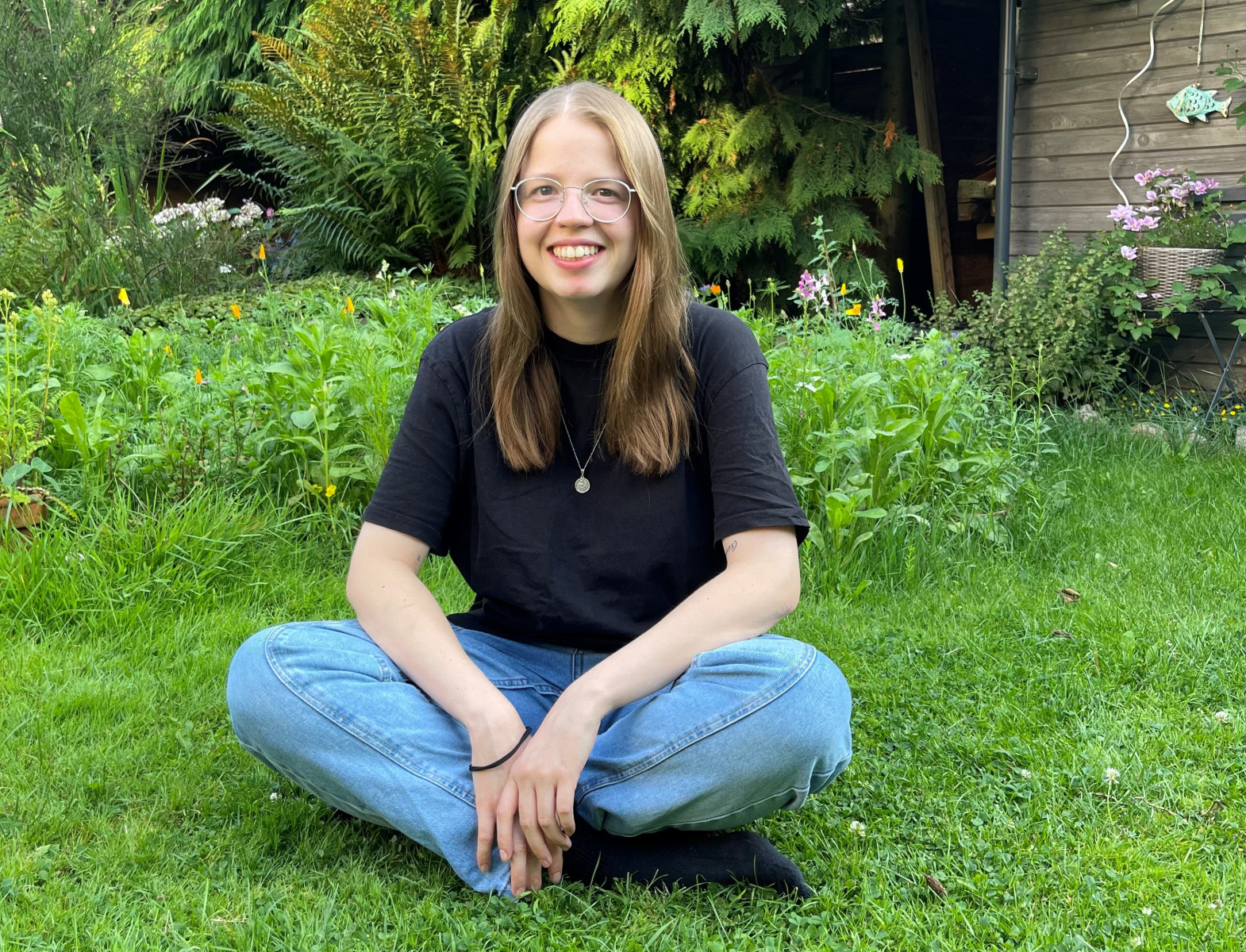
The graduate was inspired by her participation in a queer* film festival in Hamburg that focussed on lesbian literature. The projects presented there, including "Älter werden unterm Regenbogen", sparked her interest in the needs of older queer* people. "I want to draw attention to the fact that there is hardly any space for queer* seniors and that institutions should deal with their history in order to create acceptance and safety," says Ockelmann, and continues: "My work aims to create institutional structures that support this. I want open institutions to address this issue and treat queer* people with openness and respect. Older generations should no longer have to hide. It should become a matter of course to support and value all people for who they are."
After dropping out of her first degree at a state university, Melissa Ockelmann decided to do a federal voluntary service at a children's and youth organisation. The practical work there inspired her so much that she then decided to do a dual study programme in social work at IU International University of Applied Sciences. She explains: "The dual study programme at IU was the perfect way to build on my federal voluntary service and gain further practical experience. My experience at a state university showed me that it wasn't as varied there. The concept of IU, two days of study and three days of practical work, convinced me. Especially in social work, it is important to gain practical experience right from the start. You can put what you've learnt directly into practice, which is worth so much."
In the dual study programme at IU, students gain practical experience in a company in the region alongside theory in lectures and seminars. The split-week time model allows students to directly apply and test the knowledge they have learnt. Students complete the theoretical part of the programme either in the traditional way on campus, via online teaching or from any location on the Virtual Campus.
IU as the largest academic training institution for social work
IU currently trains around 30,000 people in the field of health and social work and is the largest academic training centre for social work. Students can acquire in-depth knowledge and qualify for a variety of professions in the social sector through distance learning programmes (bachelor's, master's, MBA), dual study programmes and continuing education courses at the IU Academy.
About the IU Diversity Award
IU International University of Applied Sciences has presented the IU Diversity Award twice a year since 2018. The jury consists of a ten-member team of employees from various departments. IU students from Germany and abroad have the opportunity to submit their bachelor's or master's thesis. The IU Diversity Award is intended to help raise public awareness of the research field of diversity and is endowed with a prize of 500 euros. Further information on equality and diversity at IU can be found at: iu.de/hochschule/diversity-und-gleichstellung/
*The spelling "queer* people" is used to explicitly emphasise the diversity within the queer community. The asterisk (*) stands for a conscious openness and inclusion of different identities and orientations that fall under the term "queer".
With over 120,000 students, IU International University of Applied Sciences (IU) is the largest university in Germany. The private, state-recognised educational institution, based in Erfurt, began teaching in 2000 and now has 24 campuses as well as a virtual campus. IU stands for maximum flexibility in study: whether through dual study, distance learning or on campus – students from over 160 nations tailor their educational path to suit their individual circumstances. With more than 200 degree programmes at bachelor’s, master’s and MBA level, IU imparts practical skills. Innovative learning concepts foster targeted, future-proof skills for an increasingly AI-driven world of work. A modern, digitally supported learning environment and the use of artificial intelligence enable effective, personalised learning. As a pioneer in this field, IU has developed its own digital learning companion, ‘Syntea’, which has been in use since 2023. A network of over 15,000 companies – including Motel One, Vodafone, AWO and Deutsche Bahn – makes IU a strong partner in the training of skilled workers and consistently links academic teaching with practical experience. Further information at: iu.org
Contact

|
IU International University of Applied Sciences Press Department |