
ZuKo4Saxony project promotes future skills of Saxon companies and dual-study students
IU is a research partner in the collaborative project for the development of a digital learning environment
IU International University of Applied Sciences is a research partner in the collaborative project for the development of a digital learning environment.
- The project, funded by the European Social Fund and the Free State of Saxony, aims to make Saxon small and medium-sized enterprises (SMEs) fit for the future and to strengthen the dual training model.
- A new digital learning platform improves personnel and organisational development to promote and retain dual-study students.
- According to a survey of SMEs, skills such as problem-solving ability, cooperative working methods and communication skills are crucial levers for remaining competitive in the future.
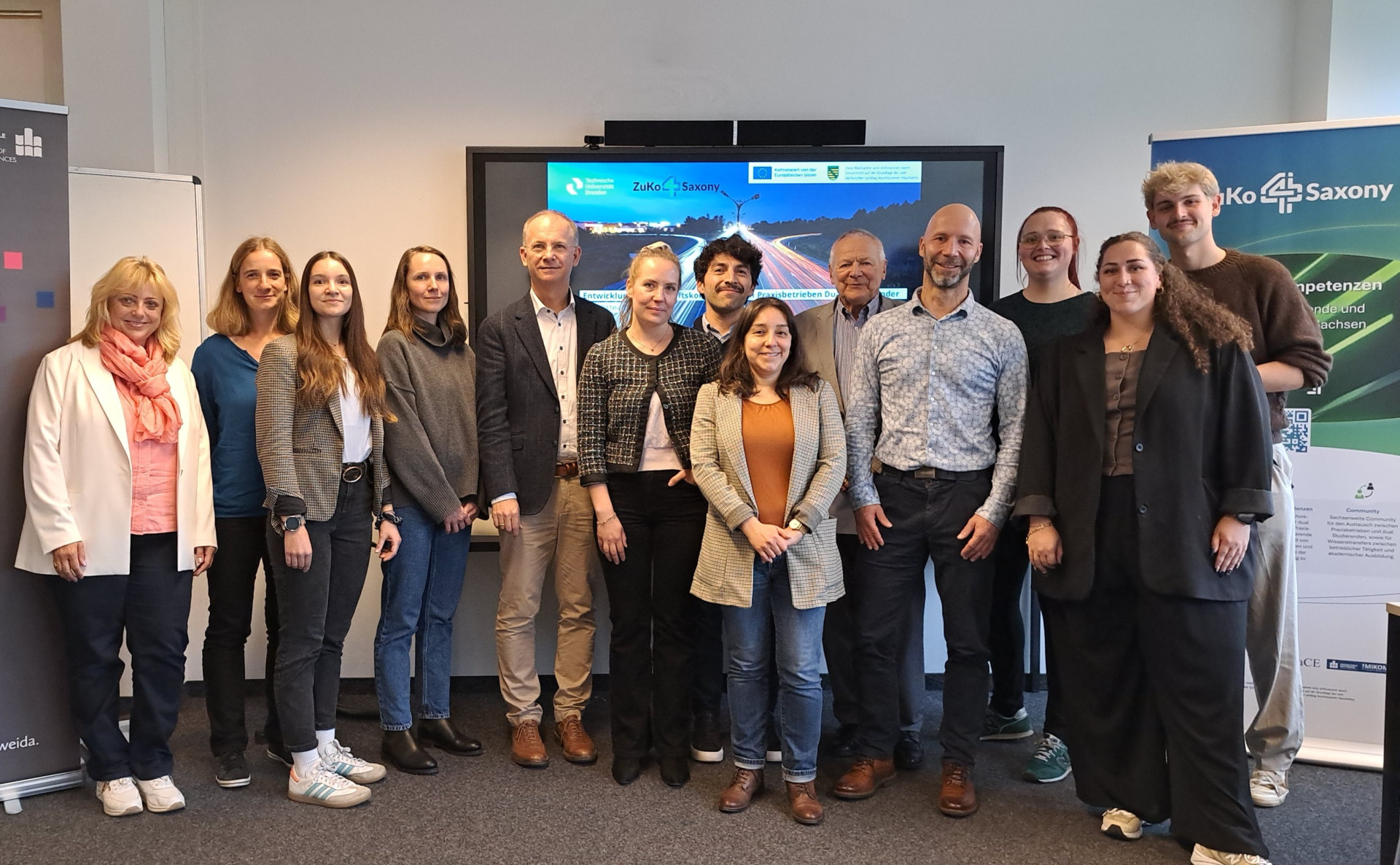
Dresden, 16 January 2026. As part of the ZuKo4Saxony research project, IU International University of Applied Sciences, together with its project partners, is developing learning content for a digital platform that will enable small and medium-sized enterprises (SMEs) in Saxony to specifically impart to dual-study students those future skills that are becoming indispensable in an increasingly digital, dynamic working world.
Dual study models, such as those offered by IU in Dresden and Leipzig, provide practical experience from day one – but small and micro-enterprises in particular often face the challenge of lacking the necessary capacities and structures to support students in a future-oriented way during their practical phases.
While large companies maintain dedicated departments and establish internal programmes for this purpose, smaller businesses often lack the time, systemic training tools, and awareness of sustainable and strategic resource allocation. This is precisely where ZuKo4Saxony comes in. The project, funded by the European Social Fund and the Free State of Saxony, is being implemented jointly under the leadership of the Dresden University of Technology (TUD), together with IU International University of Applied Sciences, the Mittweida University of Applied Sciences (MIKOMI), and the TU Dresden Institute of Further and Continuous Education GmbH (TUDFaCE). Within the project, IU, under the direction of Prof. Dr Helge Fischer, Ulrike Schroer, and Sophie Hollmann, is responsible for developing the subject matter and concepts for future skills and for the direct involvement of the practical partners.
“The aim of the project is to develop an innovative and modular digital learning platform that offers companies quick, flexible, and practical access to relevant future skills,” says Prof. Dr Helge Fischer. “Pure specialist knowledge and traditional qualifications alone will no longer be sufficient in the long run. We want to enable SMEs to sustainably improve the quality, support, and professional development of their students. This strengthens both their competitiveness and their attractiveness as employers.”
Future Skills – Requirements of a New Working World
Digitalisation, globalisation, and demographic change will require new skills in the future to remain competitive in complex work structures. While the term "future skills" is established in academic circles, many SMEs still lack a concrete practical application. ZuKo4Saxony is the first to systematically transfer this concept to Saxony's SMEs.
As part of the first phase of the project, a comprehensive empirical survey was conducted among 113 Saxon SMEs, providing essential insights into their challenges and needs.
Small and medium-sized enterprises in Saxony see the highest relevance in skills such as self-management/reflection, ambiguity and problem-solving ability combined with strong communication and cooperation skills.
In a more in-depth analysis, Saxon SMEs consider the following skills to be extremely relevant for remaining competitive in the future:
- Dimension 1: Subject-development-related competencies
Here, self-reflection (96 per cent), intrinsic motivation (96 per cent), adaptability (96 per cent), self-directed learning (95 per cent) and willingness to take responsibility (93 per cent) are the supporting pillars for future viability. - Dimension 2: Individual-object-related competencies
Here, problem-solving (96 per cent), information literacy (93 per cent), flexibility (91 per cent), creativity & innovative thinking (86 per cent) stand out. - Dimension 3: Organization-related competencies
Teamwork skills (96 per cent), dialogue/consensus and criticism skills (93 per cent each), language skills (92 per cent) and social intelligence (91 per cent) are key levers for SMEs in Saxony.
It also becomes clear that SMEs need practical, digital, and work-integrated training formats. Project-oriented work and digital learning opportunities are particularly highly valued by over 80 per cent of companies. Interactive and subject-focused online formats, videos, and lectures are the preferred learning methods. For half of the respondents, collaboration with universities is also relevant. Further results can be found in the white paper accompanying the study (conducted by TUDFaCE).
The results of the first project phase are directly incorporated into the development of the digital learning content.
Practical benefits for SMEs
ZuKo4Saxony is specifically aimed at small and medium-sized enterprises in Saxony that want to offer modern skills development without significant financial or organisational effort. The digital learning platform is designed to support them in providing needs-based support for dual-study students, actively shaping transformation, and retaining skilled workers in the long term.
The project makes a significant contribution to strengthening Saxony's small and medium-sized enterprises for future challenges and further expanding the attractiveness of dual study models.
SMEs sought for pilot phase
Companies in Saxony are invited to test the learning platform in advance and actively participate in its further development until its official launch. All employees – regardless of level or function – will have full access to the training content. The project team will gather feedback on the platform through a short evaluation at the beginning and end of the trial period. The first test run will begin in February. The official launch of the learning environment is planned for 2027.
Those interested can find further information and the opportunity to register at: https://www.zuko4saxony.de/
The project managers are happy to be available for interviews and background discussions. Please send your inquiries to zuko4saxony@iu.org.
With over 120,000 students, IU International University of Applied Sciences (IU) is the largest university in Germany. The private, state-recognised educational institution, based in Erfurt, began teaching in 2000 and now has 24 campuses as well as a virtual campus. IU stands for maximum flexibility in study: whether through dual study, distance learning or on campus – students from over 160 nations tailor their educational path to suit their individual circumstances. With more than 200 degree programmes at bachelor’s, master’s and MBA level, IU imparts practical skills. Innovative learning concepts foster targeted, future-proof skills for an increasingly AI-driven world of work. A modern, digitally supported learning environment and the use of artificial intelligence enable effective, personalised learning. As a pioneer in this field, IU has developed its own digital learning companion, ‘Syntea’, which has been in use since 2023. A network of over 15,000 companies – including Motel One, Vodafone, AWO and Deutsche Bahn – makes IU a strong partner in the training of skilled workers and consistently links academic teaching with practical experience. Further information at: iu.org
Contact

|
IU International University of Applied Sciences Press Department |