
Study on AI in Higher Education: Students learn faster and more efficiently
The representative “University Experience Study 2026” shows that the majority of students and alumni work faster and more efficiently thanks to AI. See more results!
Erfurt, Germany, 22 July 2026. According to the World Economic Forum (WEF), education and training should place greater emphasis on developing the skills needed in a changing world of work – including the safe and responsible use of artificial intelligence. Universities therefore face a particular challenge in preparing students for these demands.
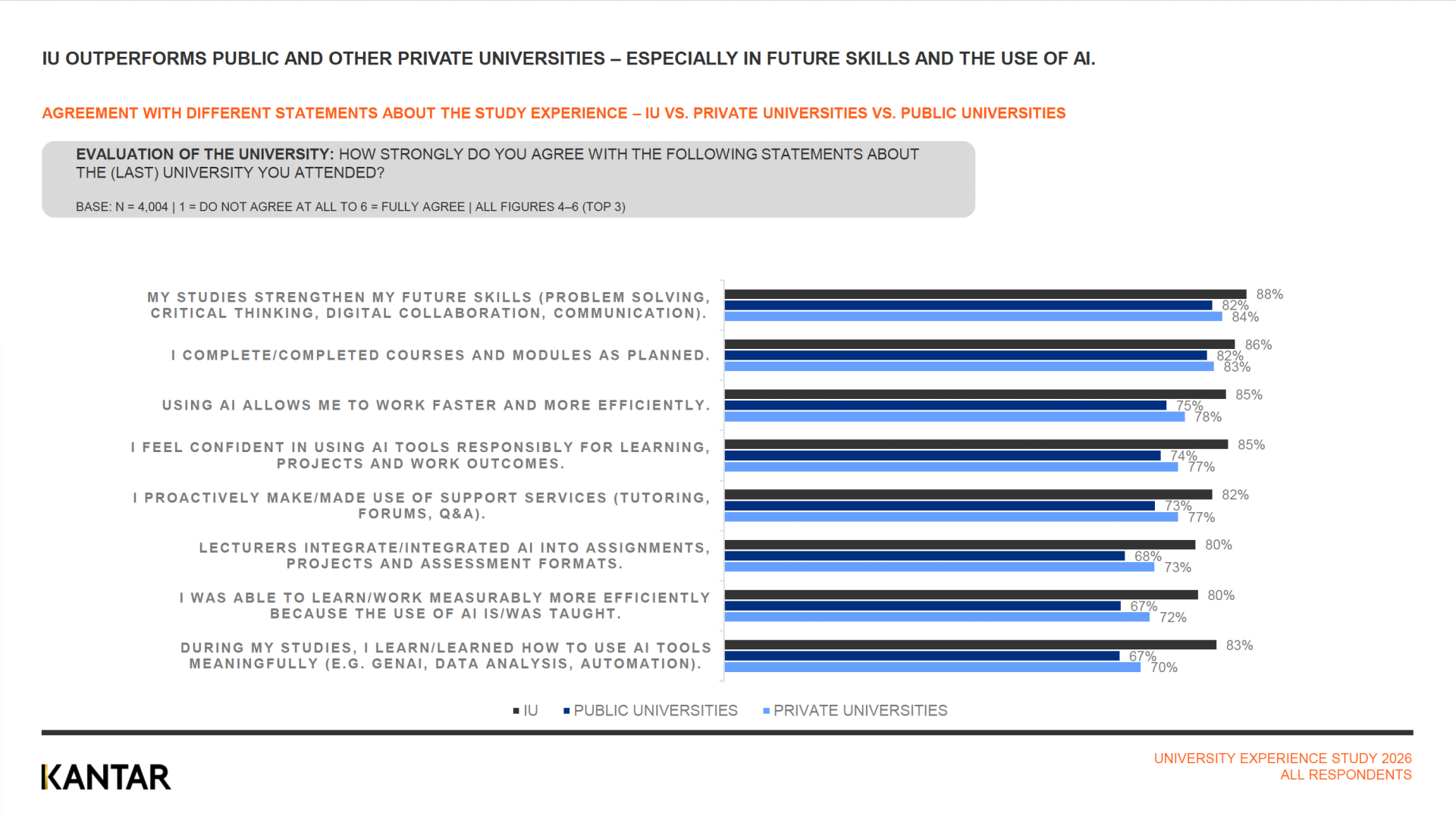
The representative “University Experience Study 2026” shows that the majority of students and alumni work faster and more efficiently thanks to AI. Three-quarters of students and alumni at state universities reported this, whilst at private universities (excluding IU) the figure is almost eight in ten. At Germany’s largest private university, IU International University of Applied Sciences, as many as 85 per cent report efficiency gains through AI. Over 4,000 students and graduates were surveyed by Kantar Profiles on behalf of IU International University of Applied Sciences.
AI is part of the curriculum, particularly at private universities
To ensure that skills do not remain abstract, students must practise and apply them in a practical way during their studies. Whilst more than two-thirds of respondents from state universities state that artificial intelligence has found its way into assignments, projects and assessment formats (68 per cent), the figure at private universities (excluding IU) is almost three-quarters (73 per cent). At IU, as many as eight in ten report that AI is an integral part of their studies. Furthermore, the vast majority (83 per cent) of IU students and graduates agree with the statement that they have learnt how to use AI tools effectively. By comparison, the figure is seven in ten at other private universities and two-thirds (67 per cent) at state universities.
“In Germany, we still too often teach in a way that is out of touch with reality. At IU, we have made it our mission to change that – and we are proud that this is resonating with our students and graduates,” says Schütt. “With our personal AI learning assistant Syntea, we have long been demonstrating how AI can be meaningfully integrated into teaching,” says Schütt. “With our Job Readiness Framework, we have also been incorporating fixed AI courses into our curricula as part of a major pilot project since April. In doing so, we are addressing the needs of businesses in a highly practical way: we are teaching today the skills that will be needed on the labour market tomorrow.” In the survey, nine out of ten IU graduates state that they feel confident in using AI tools responsibly, putting them ahead of other universities (benchmark: 73 per cent).
Future skills in higher education to prepare for the job market
Ever since the widespread adoption of generative AI in the workplace, one thing has become clear: repetitive and standardised tasks, in particular, are increasingly being automated (WEF 2025). “Universities must therefore place greater emphasis on equipping students with skills such as critical thinking, problem-solving, communication and digital collaboration,” says Schütt. The vast majority of IU graduates agree: 96 per cent state that their degree has strengthened their future skills (benchmark: 83 per cent). “With these future-oriented skills, we are preparing them for a world of work in which it is not enough to know what AI can do. What is crucial is to understand where humans continue to have the edge – and how they can achieve better results by working together with AI,” says Schütt.
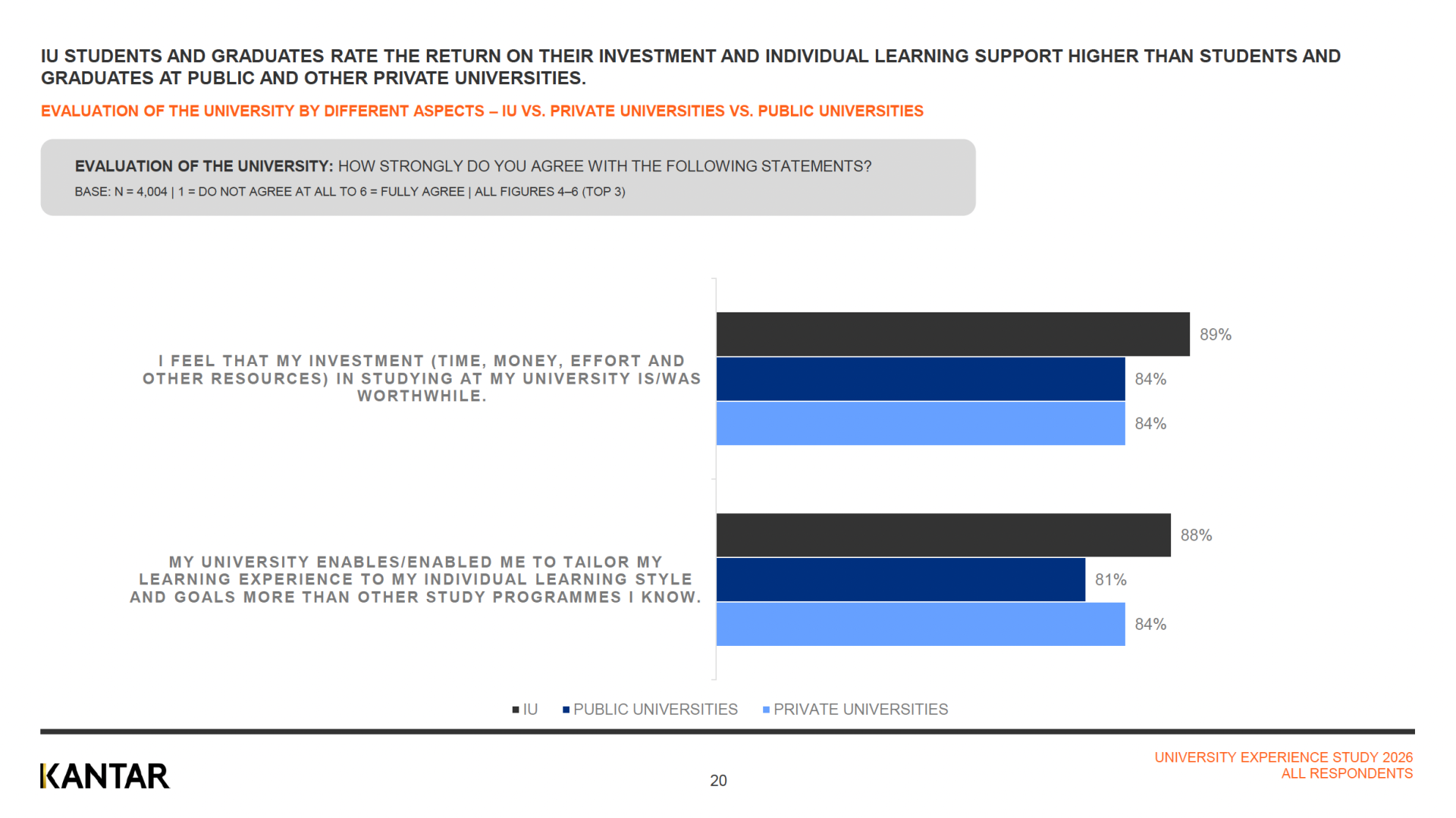
ABOUT THE SURVEY
The survey was conducted by Kantar Profiles between 27 August and 20 October 2025. A total of 4,004 students and graduates from public and private universities were surveyed, including 1,597 alumni, representative in terms of age and gender. The target group was alumni from the last five years, students and university dropouts. The survey was commissioned by IU International University from Kantar Profiles. The data was collected independently by Kantar Profiles in accordance with internal quality standards.
Methodology:
To ensure the best possible comparability between universities, three different comparisons were chosen: a) Comparison of ‘public university vs. private university (excl. IU) vs. IU’ and b) ‘IU vs. benchmark’ and c) Public vs. private universities: In a), IU is compared with public and private universities. Individuals who study or have studied at IU are considered separately and are not assigned to private universities. In IU vs. benchmark (b), state and private universities are combined into one cohort and compared with IU students and alumni. In c), all state and private universities (including IU) are combined into one group.
With nearly 130,000 students, IU International University of Applied Sciences (IU) is the largest university in Germany. The private, state-recognised educational institution, based in Erfurt, began teaching in 2000 and now has 37 campuses. IU stands for maximum flexibility in study: whether through dual study, distance learning or on campus – students from over 160 nations tailor their educational path to suit their individual circumstances. With more than 200 degree programmes at bachelor’s, master’s and MBA level, IU imparts practical skills. Innovative learning concepts foster targeted, future-proof skills for an increasingly AI-driven world of work. A modern, digitally supported learning environment and the use of artificial intelligence enable effective, personalised learning. As a pioneer in this field, IU has developed its own digital learning companion, ‘Syntea’, which has been in use since 2023. A network of over 15,000 companies – including Motel One, Vodafone, AWO and Deutsche Bahn – makes IU a strong partner in the training of skilled workers and consistently links academic teaching with practical experience. Further information at: iu.org
Contact

|
IU International University of Applied Sciences Press Department |