
How inclusion can succeed in Hamburg's daycare centers
Jenny Elisa Pabst develops guidelines for action and is awarded the IU Diversity Award 2025
Jenny Elisa Pabst develops guidelines for inclusive daycare practice and is awarded the IU Diversity Award 2025.
Hamburg, 12 January 2026. How can genuine inclusion be achieved in daycare centers? This question is gaining additional urgency in Germany in light of growing diversity and structural challenges. While approximately 41 percent of all daycare centers care for children receiving integration assistance (see Statista), at the same time, in many places, pedagogical staff are still not sufficiently prepared for the specific needs of neurodivergent children, which presents obstacles for those affected and their families.
Jenny Elisa Pabst, from Hamburg, investigated in her master's thesis at IU International University of Applied Sciences how Hamburg daycare center directors promote the diversity skills of their teams with regard to the inclusion of autistic children. Pabst will receive the IU Diversity Award 2025 for this work. This award is presented twice a year by IU and recognises outstanding theses that address diversity, equal opportunities, and social participation in a scientifically sound and practically relevant manner.
“With her work, Jenny Elisa Pabst makes an important contribution to the further development of inclusive practices in early childhood education. Her findings illustrate the key role that managers play with regard to inclusion and how they can contribute to it. Her work combines in-depth expertise with great professionalism and empathy,” explained Ariane Weber, staff member in the Equal Opportunities Office of IU International University of Applied Sciences and project manager of the IU Diversity Award, justifying the jury's decision.
Inclusive daycare centers need strong leadership.
The award-winning master's thesis by Jenny Elisa Pabst focuses on how managers in daycare centers can specifically promote the diversity skills of their staff in order to enable inclusive and discrimination-sensitive practices. The focus is on the inclusion of autistic children, who in everyday daycare life still face structural barriers as well as normative and sometimes discriminatory notions of "disability" and "autism."
The results of the master's thesis clearly show that daycare center directors play a key role . They act as multipliers between children, staff, the sponsoring organisation, and families, and can make a significant contribution to an inclusive organisational culture. At the same time, it becomes clear that Germany still has considerable ground to make up in implementing the UN Convention on the Rights of Persons with Disabilities – particularly in the areas of accessibility and structural support.
Nevertheless, Pabst observes a positive development: "Societal understanding of autism and neurodiversity is growing noticeably."
Science, practice and personal perspective
Jenny Elisa Pabst's motivation for her thesis grew over several years. Even during her bachelor's degree in social work, she worked continuously in educational settings with neurodivergent children, completed internships, and participated in university research projects on equal opportunities for preschool children. She subsequently continued this commitment as a manager in an inclusive preschool. Currently, Pabst works in the preschool provider advisory service of the Hamburg BSFB (Association for Social Services and Family Support), advising preschool providers and childcare facilities, including on the topics of inclusion and autism.
Her empirical study is based, among other things, on interviews with daycare center directors who, despite high motivation, are often limited in their work by restricted time, personnel, and financial resources. These lack of resources can ultimately lead to barriers in the care of autistic children in daycare centers and restrict their access to childcare services. The work gains particular depth through its own neurodivergent perspective, which is reflected upon and professionally integrated into the research.
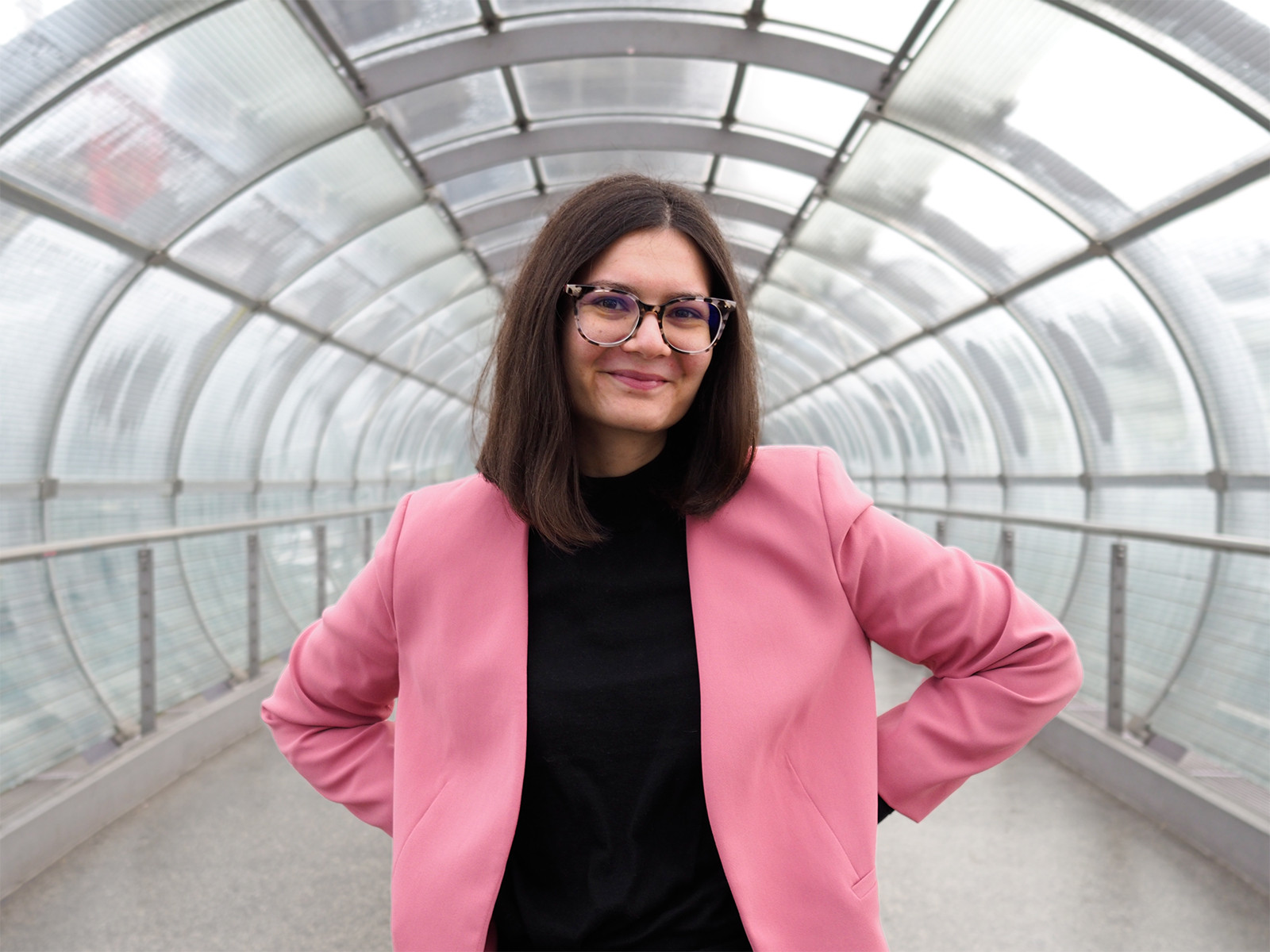
“What’s special about this work is the consistent connection between scientific findings and professional practice,” says Pabst. “My goal is that research doesn’t just sit on a shelf, but provides concrete support to children, families, professionals, and organisations.”
As part of her master's thesis, Pabst collaborated with daycare center directors from six of Hamburg's seven districts, whom she does not professionally supervise. She will strategically share the insights gained within her professional field and apply them in her consulting practice so that as many Hamburg daycare centers, children, and families as possible can benefit.
Studying as a solution for self-realization
Jenny Elisa Pabst comes from a non-academic background and is therefore particularly proud of her master's degree in "Pedagogy, Educational Counseling, and Leadership," which she was able to finance in part with a Germany Scholarship. Distance learning at IU gave her maximum flexibility to combine work, family, and studies. Thanks to modern digital teaching methods and additional courses for acquiring future skills, she is now also considered an "AI expert" on her team.
“Special thanks go to my programme director, Karin Thiel. The professional exchange with her, as well as with numerous other lecturers and fellow students, was incredibly helpful in my successful graduation,” said Pabst. She doesn't rule out pursuing a doctorate in the future, but above all wants to remain in the field and actively contribute to quality development in childcare.
About the IU Diversity Award
IU International University of Applied Sciences has been awarding the IU Diversity Award twice a year since 2018. The jury consists of a ten-member team of staff members from various departments. IU students have the opportunity to submit their bachelor's or master's theses. In 2025, in addition to Jenny Elisa Pabst, Alina Klein from Bochum also received the award for her work on improving the treatment of queer refugees in Germany. The IU Diversity Award aims to contribute to raising public awareness of diversity research and includes a prize of 500 euros. Further information on equality and diversity at IU can be found at: https://www.iu.de/en/university/diversity/
With nearly 130,000 students, IU International University of Applied Sciences (IU) is the largest university in Germany. The private, state-recognised educational institution, based in Erfurt, began teaching in 2000 and now has 37 campuses. IU stands for maximum flexibility in study: whether through dual study, distance learning or on campus – students from over 160 nations tailor their educational path to suit their individual circumstances. With more than 200 degree programmes at bachelor’s, master’s and MBA level, IU imparts practical skills. Innovative learning concepts foster targeted, future-proof skills for an increasingly AI-driven world of work. A modern, digitally supported learning environment and the use of artificial intelligence enable effective, personalised learning. As a pioneer in this field, IU has developed its own digital learning companion, ‘Syntea’, which has been in use since 2023. A network of over 15,000 companies – including Motel One, Vodafone, AWO and Deutsche Bahn – makes IU a strong partner in the training of skilled workers and consistently links academic teaching with practical experience. Further information at: iu.org
Contact

|
IU International University of Applied Sciences Press Department |